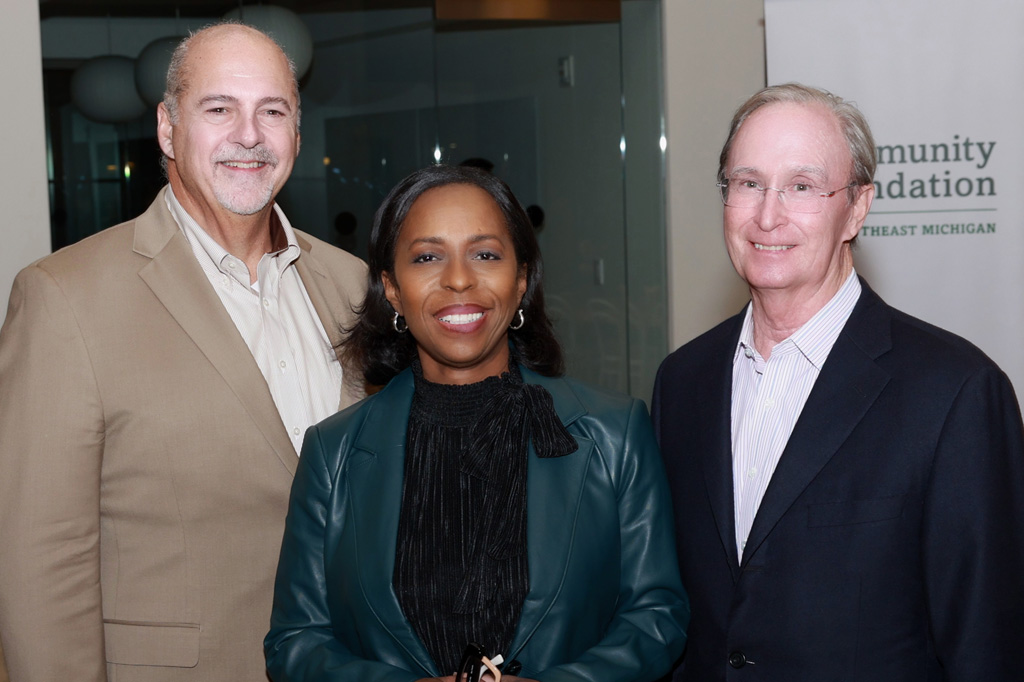
Photo: The Community Foundation for Southeast Michigan recently hosted a conversation called “Examining the Economics of Healthcare,” focused on Health Equity. It featured Bob Riney, president and CEO of Henry Ford Health System, left; Nicole Sherard-Freeman, president and CEO of the Community Foundation; and John D. Lewis, retired chairman of Beaumont Health and a current Community Foundation trustee.
The Community Foundation for Southeast Michigan is committed to being a thought leader around our five focus areas of Economic Opportunity, Health Equity, Youth and Education, Arts and Culture, and Public Space and Environment.
We believe that no single system, including philanthropy, can solve the challenges or activate the opportunities these focus areas present. Instead, we must work together with government, the private sector and community partners to make progress toward our shared vision of a thriving southeast Michigan.
To that end, the Community Foundation seeks to shine a light on the issues and share ideas about how we can jointly expand equitable access to opportunities throughout southeast Michigan. This was the goal of a set of engagement efforts we hosted in 2025 called the “CFSEM Conversation Series.”
“Examining the Economics of Healthcare,” which closed out the series, focused on Health Equity. It featured Bob Riney, president and CEO of Henry Ford Health System; John D. Lewis, retired chairman of Beaumont Health and a current Community Foundation trustee; and Nicole Sherard-Freeman, president and CEO of the Community Foundation.
As federal funding and policies have reshaped the health care landscape, this special event explored the complex economics of health care; the future of equitable access; and how public, private and philanthropic partnerships can build a stronger, healthier region for all.
The event also offered a glimpse into what it’s like to have the Community Foundation for Southeast Michigan as a philanthropic partner on the focus areas that matter most to you.
This story first appeared in the Spring/Summer 2026 REPORT Newsletter